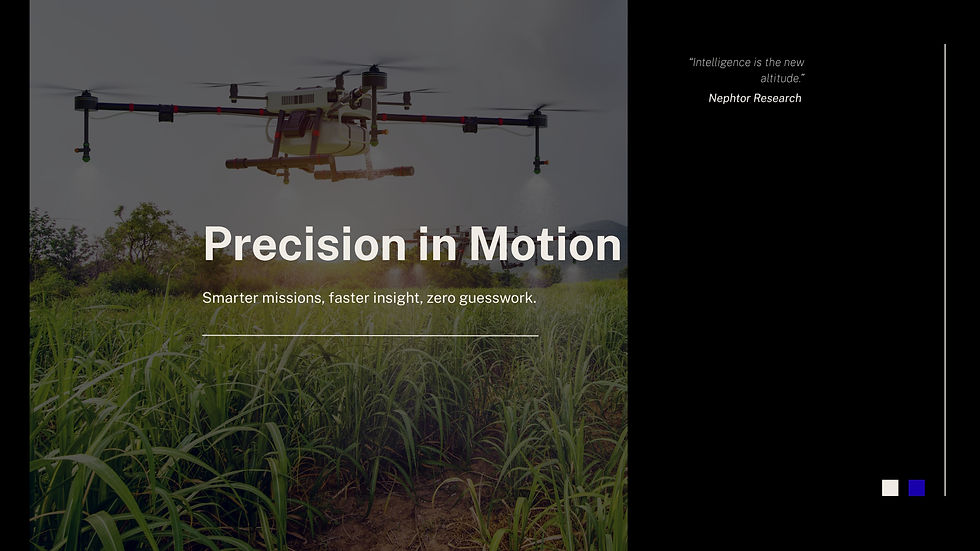
Autonomous Drone Flight Planning
How AI, sensors, and real-time data transform drone mission execution.
How AI, sensors, and real-time data transform drone mission execution.
Autonomous drone flight planning is the foundation of next-generation aerial automation.
It combines AI navigation, sensor fusion, obstacle prediction, and mission optimization to enable drones to fly precise routes without human control. These systems allow operators to scale inspections, mapping, security, and agricultural monitoring far beyond manual capabilities.
The planning engine combines terrain maps, GPS/RTK data, AI prediction models, and obstacle-avoidance sensors. Routes are automatically generated using mission templates such as grid surveys, orbit inspections, linear asset patrols, or boundary scans. The system then simulates the mission, adjusts altitude and speed, and optimizes the path based on battery life, environmental conditions, and sensor payload.
Method
Traditional drone flights rely heavily on manual piloting, which limits accuracy, increases human error, and reduces operational scalability. Autonomous flight planning removes these limitations by generating missions based on environmental data, 3D terrain, and real-time conditions. This allows drones to execute sophisticated routes repeatedly, safely, and with centimeter-level precision.
Insight

AI-enhanced path planning continuously adjusts the mission mid-flight. Sensor fusion from cameras, LiDAR, ultrasonic sensors, and onboard prediction models enables real-time risk assessment and micro-corrections. The system re-routes automatically, maintains safety corridors, and ensures uninterrupted mission execution even in changing conditions.
Solution
The core challenge in autonomous flight lies in unpredictability: sudden wind changes, GPS drift, environmental obstacles, restricted zones, and highly dynamic environments like construction sites or agricultural fields. Without predictive intelligence and redundancy, drones risk collision, mission failure, or incomplete data collection.
Challenge

Impact on Industry
Autonomous drone flight planning enables organizations to scale aerial operations effortlessly. Agriculture gains uniform crop scans; logistics gains automated yard monitoring; security gains 24/7 patrol capabilities; inspection teams gain faster, safer workflows. The shift from manual to autonomous flight represents a step toward fully automated air operations across all industries.